Stories that shape us and the businesses we build
You can explain your business model, describe your services and talk enthusiastically about the difference you want to make. Then someone asks why you started, and suddenly the words become harder to find.
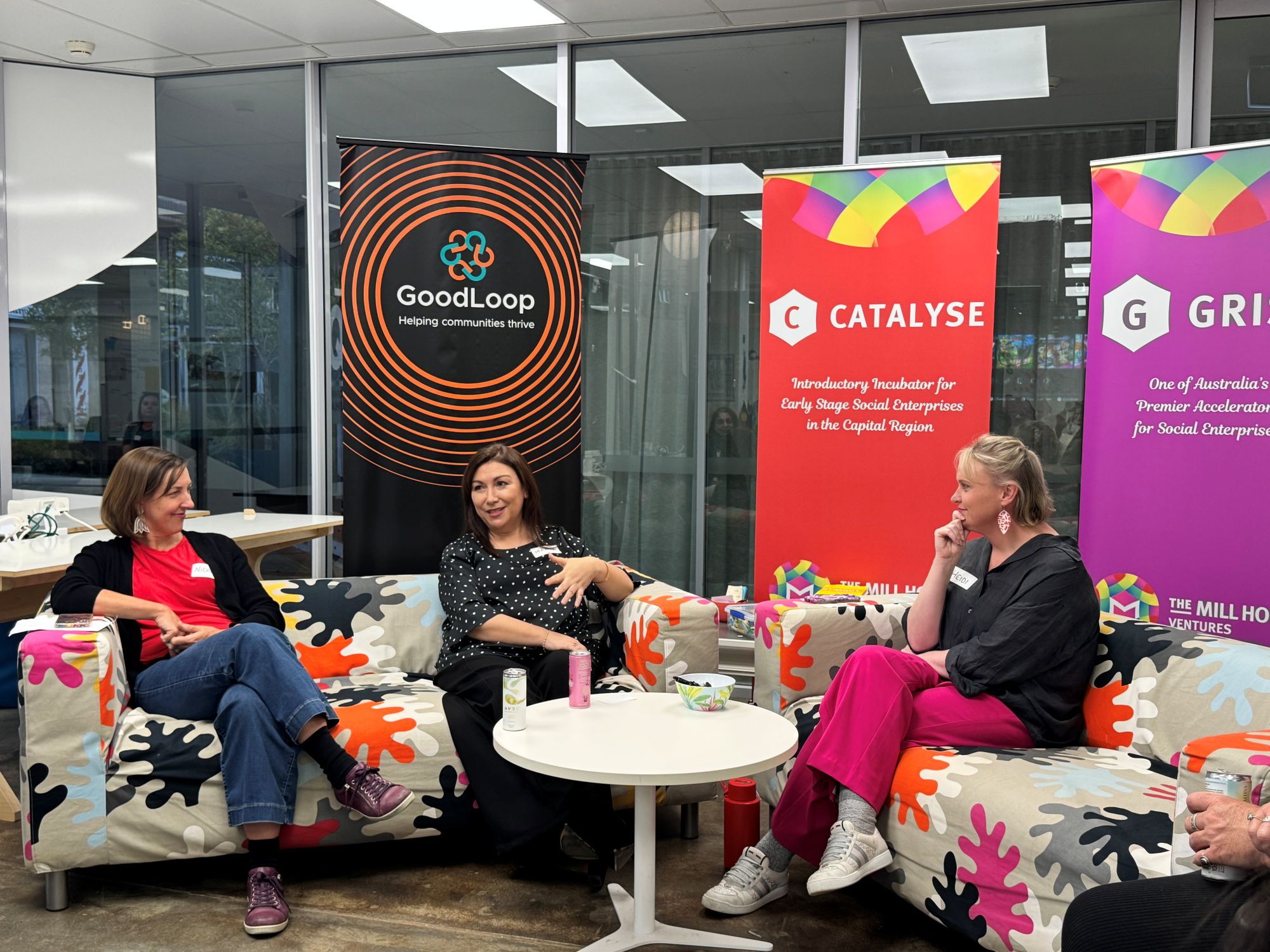
That tension sat at the heart of Stories that shape us, our final Impact After Hours for 2026. On Thursday 15 October, founders gathered at the Social Enterprise Hub at the University of Canberra for a conversation about the personal stories behind social enterprises, and the sometimes uncomfortable business of sharing them.
Our guests were Maria Jerez, founder of Accessilife, and Heidi Prowse OAM, founder of Purpose Media Canberra. Both are building businesses that help people connect with their communities and find support. Both have learnt that explaining the work takes practice, even when its purpose feels obvious to the person doing it.
For Maria, Accessilife began with the daily reality of finding support for her son, Mateo, who lives with disability and requires assistance across every aspect of his life. Finding suitable products, services and activities meant searching across a fragmented landscape while already managing substantial caring responsibilities.
The difficulty was exhausting. It could also feel isolating. If these things were so hard to find, was she somehow the only person looking for them? Her response began with a question that other founders might recognise.
That question became Accessilife: an online platform bringing together a directory of disability providers, a marketplace for new and preloved products, and a community board for events and programs. Its design grew directly from Maria’s understanding of what families needed and how little spare time they had to find it.
Heidi recognised a similar gap while knocking on doors during her ACT election campaign. Residents described services they believed did not exist in Canberra. Through her community sector experience, she often knew organisations offering relevant support, sometimes remarkably close to the people who needed them.
Those conversations helped shape Purpose Media Canberra. The enterprise shares local stories, builds connections with audiences and helps organisations develop their own communications capability. Heidi described wanting to build a relationship with people through stories they enjoy, so they have somewhere familiar to turn when they need help.
The connection between the two businesses was clear. Each founder had encountered people struggling to find something valuable that already existed. Each was working to make those connections easier.
But knowing the problem intimately does not automatically make it easy to explain. Maria described early conversations in which she listed what her platform did, without yet having the language to distinguish customers, beneficiaries or the particular value of her lived experience.
Support through Mill House and the AMP Foundation helped her recognise that experience as a strength. It informed the decisions behind the platform and helped explain why she was committed to building it. With practice, she became clearer about how to communicate that connection.
For founders still refining their pitch, that distinction is useful. You can improve the explanation while staying faithful to the experience behind it. A clearer message can emerge through conversations, questions and the occasional puzzled expression across the table.
Heidi offered a practical starting point for deciding what belongs in any particular conversation: “What’s the one thing that this person needs to know?”
She described the temptation to squeeze everything into an introduction: the personal journey, the problem, the services, the impact and how the business earns money. Trying to explain all of it at once could leave an audience overwhelmed. Starting with the value relevant to that person creates room for a continuing conversation.
Maria also navigates different audiences. Families and people with disability use Accessilife to find support, while providers and community organisations need to understand how the platform connects them with those audiences. Her reason for starting remains consistent, but different listeners need different details.
The evening also made space for something less comfortable: how personal it can feel when someone does not understand your idea. Maria spoke about finding those early conversations difficult because the problem was part of her own life. Over time, greater confidence in explaining the business helped her navigate those moments.
Heidi, meanwhile, described being far more comfortable telling other people’s stories than her own. She could recognise what made someone else compelling, then struggle to find the words when attention turned towards her. Even an experienced communicator can find their own story surprisingly difficult to see clearly.
Both founders admitted that a camera could make things harder. Maria enjoys talking with people in person, but recording herself feels different. Heidi described strong messages emerging naturally in conversation, only for that ease to disappear when she tried to capture them deliberately.
One practical suggestion was to ask someone you trust to stand behind the camera and ask questions. Speaking to a familiar person can help recreate the conversation in which your explanation feels most natural. For a founder staring at a blank script, that offers a manageable place to begin.
Meeting people also provided valuable feedback. At her first Canberra Disability Expo, Maria found families quickly recognised the problem Accessilife addressed. She reported that almost everyone she spoke with registered on the spot. Seeing that recognition gave her encouragement to keep getting out and talking about the platform.
For Heidi, a memorable response came after interviewing a Canberra lawyer about his community involvement. His wife commented that the article had found words she had struggled to find herself. Looking beyond a professional role to the person’s motivation had helped tell a story that someone close to him recognised.
These moments offered founders something concrete to consider: notice when people recognise themselves, ask a useful question or take action. Those responses can help you understand which parts of your message are connecting, and which need more work.
Heidi’s final advice was to give a clear message time to reach people. Founders can become tired of their own explanation long before everyone they hope to reach has heard it.
The format can vary while the central message stays familiar. A conversation, video or written story can each give someone a new opportunity to understand what you do and why it matters to them.
For your own field notes, try one small exercise: choose the person you most need to reach, write down what they need to understand, and explain it aloud to someone you trust. Ask what they remember. Their answer may help you find the next version of your story. You do not have to find the perfect wording before you begin.
Thank you to Maria and Heidi for sharing their experiences, including the parts they are still working through, and to everyone who joined our final Impact After Hours for the year.